Project Outcomes
HighScape Deliverable D6.2 “Report on simulation studies for controller tuning and validation” is now out

Advancing control strategies for next-generation electric vehicles requires not only robust design, but also rigorous validation under realistic and scalable testing conditions. Within the HighScape project, this challenge is addressed through the development and assessment of innovative control systems at the component, system and vehicle levels.
A new key result in this area is the publication of Deliverable D6.2, which focuses on simulation-based validation of control performance using advanced testing methodologies. The report builds on previous work on control strategies and provides a crucial step towards ensuring their reliability, efficiency and safety in real-world applications.
Deliverable D6.2 presents the results of simulation studies aimed at tuning and validating control systems through advanced model-in-the-loop (MiL) testing. Using the project’s simulation framework and surrogate models developed in earlier work, the report evaluates how control strategies perform across different subsystems and operational conditions.
The work builds on Deliverable D6.1, moving from control design to validation, with a focus on ensuring that the intended functionalities meet performance and safety expectations. In particular, the report explores testing approaches for both low-level and high-level controllers, addressing aspects such as electromagnetic compatibility, vehicle dynamics, energy efficiency, ride comfort and thermal management.
A key contribution of the deliverable lies in the application of multi-stage X-in-the-loop testing methods, which enable a comprehensive assessment of control behaviour before physical implementation. Special attention is given to vehicle performance controllers, which are responsible for optimally distributing control actions across multiple actuators and systems.
The results demonstrate measurable improvements in several areas. Advanced brake torque blending and one-pedal driving strategies contribute to enhanced vehicle dynamics, driver comfort and energy efficiency, as confirmed through driver-in-the-loop experiments. Energy-saving approaches such as pulse-and-glide control further optimise torque distribution to reduce consumption. In addition, new control solutions, including an advanced ABS strategy, are tested through hardware-in-the-loop simulations, highlighting their potential for improved performance.
While some components, such as the full electromechanical brake-by-wire system, are still under development, the simulations provide strong indications of their expected benefits. These will be further validated in upcoming project activities involving real hardware testing.
Access the full deliverable here.
Other Projects
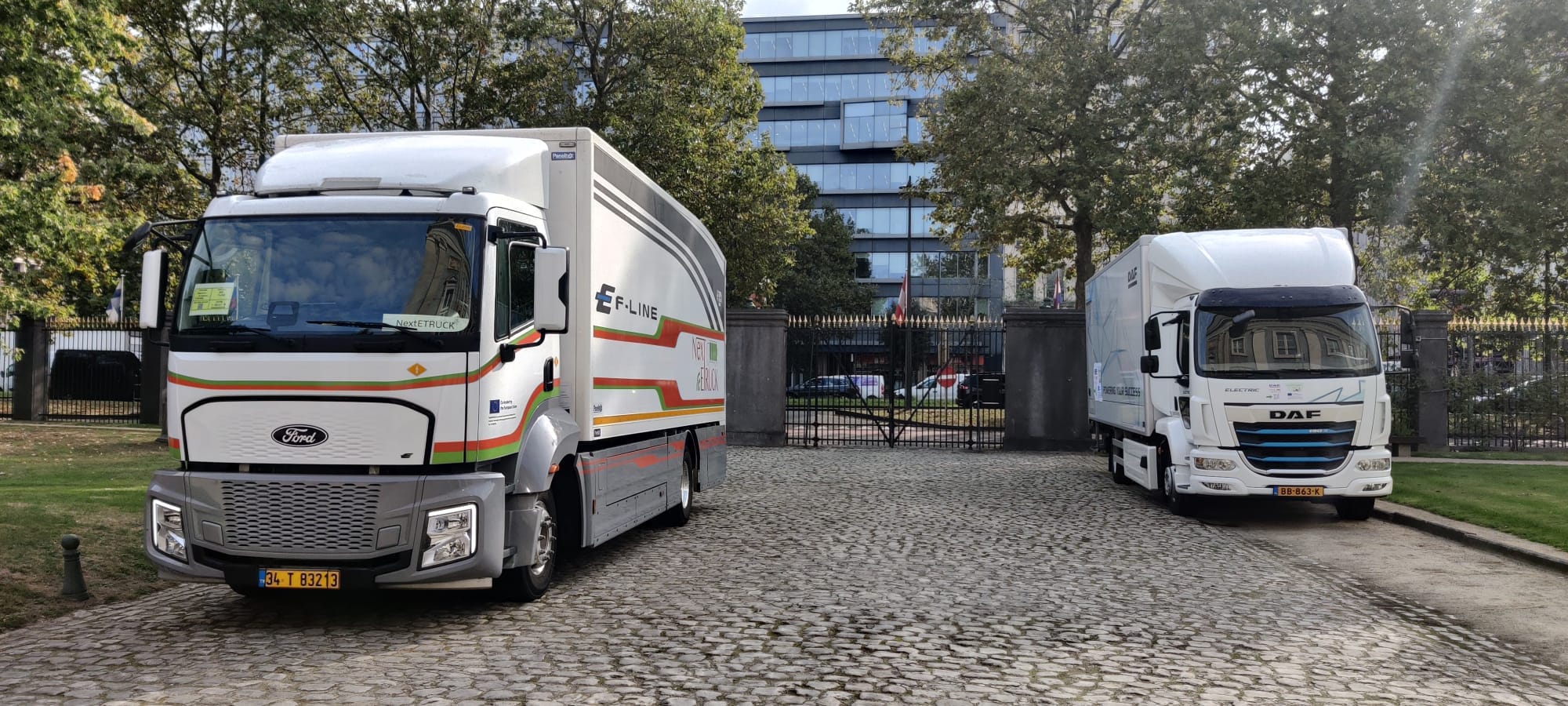
NextETRUCK Final Event: Delivering evidence and insights for the transition to zero-emission freight
The final event of NextETRUCK showcased what four years of demonstration, testing and evaluation can deliver when innovation is assessed in real operating conditions rather than in controlled environm...
Read more
InnoBMS New Publication on V2X Scenarios for Future-Proof Battery Management Systems
The 2ZERO Partnership is pleased to highlight a new open-access publication emerging from the Horizon Europe-funded InnoBMS project. The study, “Analysis of V2X Scenarios for Future-Proof Battery Ma...
Read more
New iBattMan publication advances battery health diagnostics for next-generation EVs
Battery health assessment is one of the key enablers for accelerating the adoption, sustainability, and long-term performance of battery electric vehicles (BEVs). Although current Battery Management S...
Read more